

| Color | Aqua, Blue, Green, Red |
|---|
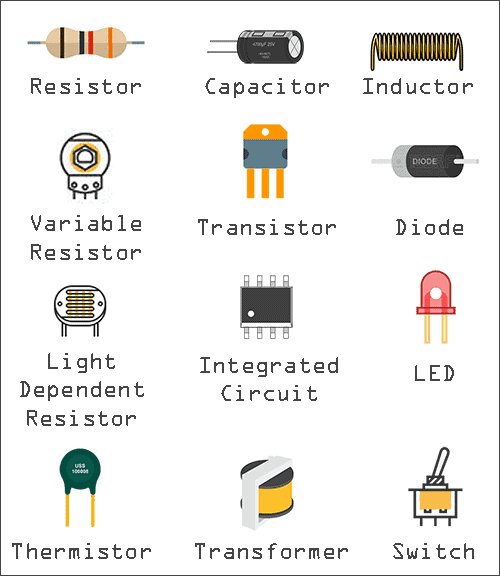
Components
Active and Passive Elements
Electronic systems are built around analog and digital components. They comprise resistors, capacitors, diodes, inductor, operational amplifiers and transistors.
These components are often called active and passive elements.
Majority of the analog circuits consist passive and active ones that are responsible for power management.
The fundamental doubt that comes for every electronics/electrical enthusiast during the graduation is what is the difference between active and passive component? But before going to know the difference, you need to know the definition of active and passive elements.
What is an Active element?
Active components control the charge flow in electronic circuits. By definition, active elements generate energy for any device. It is the core component to operate any device. The two parameters to consider for proper device operation are current and voltage.
Hence the voltage and current in a circuit may be boosted or stepped down based on the flow of electrons injected by an active device.
What is Passive element?
Passive elements are quite opposite to active ones. They don’t require any external voltage to perform their job.
But they are not capable to provide energy on their own. They require assistance from active devices.
For example, a resistor is a versatile component used as pull up or pull down resistor in most of the hardware design.
Related products
-
Relays
Components
Reviews
There are no reviews yet.